 saltar al contenido



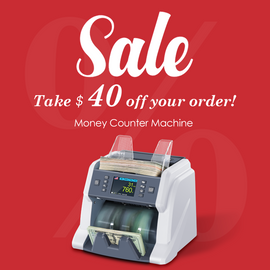


If you are a small business owner watching every dollar this January, you have probably already identified several areas where costs are eating into your profits. Staff wages continue to rise, supply chain expenses remain unpredictable, and your to-do list seems to grow longer every day. But there is one expense hiding in plain sight that you may not have fully quantified yet: the time your employees spend manually counting, verifying, and reconciling cash at the end of each day. For most retail businesses handling moderate cash volumes, this manual process consumes anywhere from thirty to ninety minutes daily, time that costs you money whether you realize it or not. As you allocate your new fiscal year budget for 2026, the question you should be asking is not whether you can afford to upgrade your cash handling equipment, but whether you can afford not to.
The mathematics of equipment investment becomes remarkably clear when you run the numbers. A quality automated currency counter that costs roughly four hundred to six hundred dollars pays for itself in labor savings within the first year alone, while simultaneously reducing your exposure to counterfeit losses and eliminating the human errors that plague manual counting processes. This is not speculation or theoretical projection; this is simple arithmetic based on the actual time your staff spends on cash handling tasks and the wages you pay them. With Q1 representing the period when you have fresh budget allocation authority and the greatest incentive to make investments that reduce ongoing operating costs, upgrading your cash management infrastructure should be near the top of your procurement list.
The Hidden Cost of Manual Cash Handling in Your Daily Operations
Walk into any small retail store during closing hours and you will likely witness a ritual that has changed little over decades: one or two employees standing at a counter, manually sorting through stacks of cash, counting bills by hand, verifying denominations, and recording totals in a ledger or basic spreadsheet. This scene plays out thousands of times across small businesses every single night, consuming hours of labor that could be redirected toward customer service, inventory management, or other revenue-generating activities. The process is slow, error-prone, and provides no meaningful security benefit beyond what automated equipment can offer at a fraction of the time cost.
The actual cost of manual cash handling extends far beyond the obvious time investment. When employees spend thirty minutes or more each day on end-of-day cash reconciliation, you are paying them to perform a task that offers zero competitive advantage or customer value. That same time could be spent restocking shelves to prevent out-of-stocks, assisting customers to close additional sales, or preparing the store for the next day to reduce morning setup time. The opportunity cost is invisible in your financial statements but very real in terms of lost sales and reduced operational efficiency. Industry research consistently shows that small retail businesses lose between two and five percent of potential sales due to inadequate staffing during peak hours, and much of this shortfall stems from having employees occupied with back-office tasks like manual cash counting rather than front-line customer service.
Beyond the time cost, manual cash handling introduces significant risk factors that threaten your bottom line. Human error in counting, particularly during busy periods when fatigue sets in, results in discrepancies that consume management time to resolve and can occasionally mask employee theft or external fraud. A 2019 study by the National Retail Federation found that inventory shrinkage and cash loss combined cost the average small retailer between one and three percent of annual revenue, with cash handling errors accounting for a meaningful portion of these losses. When you consider that a fifty-thousand-dollar annual revenue business loses between five hundred and fifteen hundred dollars per year to these preventable losses, the argument for investing in automated equipment becomes compelling even before you factor in the labor time savings.
The ROI Case for Automated Cash Handling Equipment
Understanding the return on investment for cash handling equipment requires looking beyond the purchase price to examine the full picture of what you gain and what you eliminate. Let us consider a realistic scenario for a small retail business processing approximately two thousand dollars in cash transactions daily, which is typical for a convenience store, small grocery, or boutique. At closing, two employees spend an average of forty-five minutes completing cash reconciliation, including counting all cash on hand, verifying against register records, preparing bank deposits, and securing the cash for transport. At a blended labor cost of fifteen dollars per hour including taxes and benefits, this daily process costs you approximately twenty-two dollars per day in labor alone.
Over the course of a year, that forty-five minutes daily represents roughly eleven thousand dollars in labor costs devoted specifically to cash handling tasks that could be fully automated. Now consider what happens when you invest in a quality mixed denomination currency counter with CIS imaging technology. The same reconciliation process drops to approximately ten minutes, with the machine handling the counting and denomination sorting while employees perform quick verification and prepare deposits. Your labor cost for this process drops from twenty-two dollars per day to roughly five dollars, saving seventeen dollars daily or over six thousand dollars annually. The equipment pays for itself in well under one year, and that is before you calculate the value of reduced errors, improved accuracy, and faster daily close procedures.
The ROI calculation becomes even more favorable when you factor in the intangible benefits that directly impact your business. Faster cash reconciliation means your employees can leave earlier, reducing overtime costs and improving morale. More accurate counting eliminates the time managers spend investigating discrepancies and re-counting totals to verify suspected errors. Comprehensive audit trails from modern equipment provide documentation that protects you in case of disputes and creates accountability that discourages internal theft. When you add these benefits to the direct labor savings, the case for equipment investment becomes overwhelming for any business handling meaningful cash volumes.
What makes this the ideal time for investment is the technology available in the current market. Equipment that once required significant capital expenditure now delivers professional-grade performance at price points accessible to small businesses. USB firmware update capabilities mean your equipment remains useful as currency designs evolve, protecting your investment for years rather than requiring replacement when new security features appear. Mixed denomination counting, where different bill values can be processed in a single stack without sorting, dramatically speeds operations while reducing the cognitive load on employees who previously had to carefully organize cash before counting.
Choosing Equipment That Delivers Real Operational Benefits
Not all cash handling equipment offers equal value, and understanding what separates professional-grade machines from basic counters helps you make informed purchasing decisions that maximize your ROI. The critical technology to look for is CIS, or Contact Image Sensor imaging, which performs a full-surface scan of each bill rather than relying on older magnetic or infrared detection methods that can miss sophisticated counterfeits. CIS technology captures detailed images of security features including watermarks, holograms, microprinting, and other elements that distinguish genuine currency from clever counterfeits, providing authentication accuracy that manual verification simply cannot match.
Speed and capacity matter significantly for retail environments where efficiency directly impacts your labor costs. Look for equipment capable of processing at least six hundred notes per minute with high accuracy rates, ensuring that even large daily cash volumes can be counted quickly without creating bottlenecks in your closing procedures. Batch and stack processing capabilities allow your employees to feed mixed denomination piles into the machine without first sorting by bill type, saving additional time while reducing the chance that employees will skip proper counting steps when feeling rushed. Hopper and stacker capacity should accommodate your peak transaction volumes without requiring multiple loading cycles.
The update capability mentioned earlier deserves particular emphasis in your purchasing criteria. Currency designs change periodically across all major currencies, with new security features introduced regularly to combat evolving counterfeiting techniques. Equipment that cannot receive firmware updates becomes progressively less capable over time and may eventually fail to authenticate legitimately updated currency. USB update functionality allows manufacturers like Ribao Technology to release authentication improvements as currency systems evolve, ensuring your equipment remains current without requiring replacement. This single feature can extend the useful life of your investment from three to five years to seven years or more, dramatically improving your long-term return.
Consider also the specific needs of your business when evaluating equipment options. If you handle multiple currencies, look for machines with multi-currency capability that can authenticate different note types. If you require detailed records for accounting or audit purposes, models with serial number recording and exportable reporting provide valuable documentation. If your bank has specific requirements for cash deposit preparation, equipment that produces properly organized and verified deposits can streamline your banking relationships and reduce fees. Taking time to identify your specific requirements before purchasing ensures you select equipment that delivers maximum value for your particular situation.
Practical Steps for Evaluating Your Equipment Needs
- Calculate your current cash handling time: Track how long your closing process takes for one week, including all time spent counting, verifying, reconciling, and preparing deposits. Multiply by your average labor cost to establish your baseline annual expenditure on this function.
- Assess your fraud exposure: Review your cash handling procedures to identify any gaps where counterfeits could enter your workflow undetected. Consider the denominations you handle most frequently and the likelihood of encountering counterfeits in your specific market.
- Research equipment options: Identify three to five models that match your requirements, comparing processing speed, accuracy ratings, update capabilities, and total cost of ownership including maintenance and potential upgrade fees.
- Request demonstrations or trial periods: If possible, test equipment in your actual workflow before committing to purchase. Many suppliers offer demonstration units or return policies that allow you to verify performance in real-world conditions.
Positioning Your Business for a Profitable 2026
The decisions you make in Q1 2026 regarding your operational infrastructure will shape your business performance for the entire year. Every dollar you invest in reducing ongoing operating costs pays dividends repeatedly throughout the year, compounding the benefit of smart early-year decisions. Cash handling equipment represents one of the clearest ROI opportunities available to small retail operators, offering predictable returns that can be calculated with reasonable certainty before you spend a single dollar. When you compare this to other potential investments with uncertain outcomes or longer payback periods, the logic for prioritizing cash handling upgrades becomes difficult to ignore.
The competitive landscape in retail continues to evolve, with customer expectations rising and profit margins remaining compressed across most categories. Businesses that find ways to operate more efficiently will outperform those that do not, and cash handling optimization represents one of the most accessible opportunities for immediate improvement. Your employees will appreciate being freed from tedious manual counting tasks, your management team will benefit from more accurate financial data, and your customers will experience faster service during checkout and closing periods. The ripple effects of this single investment touch multiple aspects of your operations in positive ways.
Take action now rather than waiting for problems to escalate. Review your current cash handling procedures, calculate the true cost of your existing process, and research equipment options that fit your budget and requirements. The businesses that thrive in competitive markets are those that continuously identify and eliminate operational inefficiencies, and manual cash handling is almost certainly one of the inefficiencies dragging down your performance. With fresh budget allocation authority in hand for the new fiscal year, you have the resources to make this upgrade happen without waiting for capital to become available later.
Explore the range of cash handling equipment designed specifically for small business needs at Ribao Technology. Our collection of mixed denomination counters, automated cash recyclers, and authentication devices combines professional-grade performance with the update capabilities and ease of use that modern retail operations require. Visit https://www.ribaostore.com/pages/contact to discuss your specific requirements with our team or browse equipment options that can transform your cash handling operations starting this quarter.