 saltar al contenido





The Federal Reserve’s January 2026 Beige Book paints a stark picture for the American retail landscape: while consumer spending remains modest, a "consistent theme" of cost pressures due to 2025 tariff actions is now reaching a breaking point. Retailers across all twelve Districts report that as pre-tariff inventories deplete, they are faced with a brutal choice: pass these costs onto increasingly price-sensitive customers or absorb the hit to their already thin margins. With Deloitte’s 2026 Retail Outlook warning that tariffs will continue to fuel inflation and dampen purchasing power, the traditional "wait and see" approach to operational efficiency is no longer viable. For the modern store owner, the most effective way to offset these external macro-pressures is not by raising prices, but by eliminating the "hidden tax" of manual cash management through bank-grade automation.
The Context: A Perfect Storm of Tariffs and Price Sensitivity
The economic climate of early 2026 is defined by a "format tug-of-war" where retailers are squeezed between rising landed costs and a consumer base that has grown weary of inflation. According to the Federal Reserve’s summary of economic conditions, low-to-moderate income consumers are becoming "increasingly price sensitive and hesitant to spend on nonessential goods." This creates a dangerous ceiling for retail pricing. When a business cannot raise its top-line revenue without losing customers, it must look inward to its operational expenses (OPEX) to find survival-level savings. Tariffs have effectively increased the cost of goods sold (COGS) by 20% to 37% in some sectors, leaving retailers with zero room for the errors, shrinkage, and labor inefficiencies that have historically plagued manual cash handling.
Furthermore, the labor market in 2026 remains tight, with many Districts reporting that firms are exploring "AI and intelligent automation primarily for productivity enhancement." In this environment, every hour a manager spends in the back office manually counting drawers, reconciling deposits, and investigating discrepancies is an hour of high-cost labor that produces zero value for the customer. The "January Reset" of 2026 has seen a surge in small business owners realizing that their most significant "leak" isn't shoplifting or external theft, but the systemic inefficiency of how they process the very lifeblood of their business: cash.
The Impact: The "Hidden Tax" of Manual Cash Handling
Manual cash handling is a silent profit-killer that acts as a regressive tax on small businesses. Industry data from early 2026 suggests that the average retail location loses between 0.5% and 1.5% of its total cash volume to "administrative shrinkage"—a combination of counting errors, mis-sorted denominations, and internal theft that goes undetected due to lack of oversight. When combined with the rising cost of labor, the ROI of manual counting becomes deeply negative. A recent ROI analysis of retail cash solutions found that automating the count can save upwards of 30 minutes per cash drawer per day. For a store with four registers, that equates to two hours of labor saved daily, or over 700 hours per year.
Beyond the direct labor costs, there is the impact of "opportunity cost." In a 2026 retail environment where "speed, convenience, and clean operations" are the primary drivers of customer loyalty, having a manager tethered to a desk counting bills is a strategic failure. If that manager were instead on the floor optimizing inventory or training staff to handle the new tariff-driven pricing dynamics, the business would be far more resilient. The lack of real-time visibility into cash levels also leads to inefficient armored car pickups and bank deposit schedules, further inflating operational costs. In short, manual cash handling is a legacy process that is fundamentally incompatible with the high-efficiency requirements of the 2026 economy.
The Solution: Technical Precision as a Margin Protector
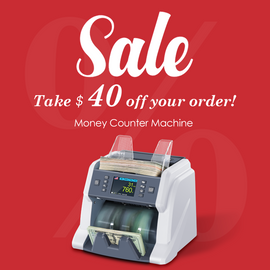
To bridge the gap between rising costs and stagnant prices, retailers are turning to technical solutions that provide bank-grade precision at a retail price point. The cornerstone of this transition is the adoption of Dual Contact Image Sensor (CIS) technology. Unlike the basic UV/MG sensors found in entry-level counters, a Dual CIS system—such as the one integrated into the Ribao BC-55—performs a full-spectrum scan of every bill. This technology doesn't just count; it validates the authenticity and denomination of mixed stacks of currency with 99.9% accuracy. By scanning both sides of the bill simultaneously, it identifies "super-fakes" and modified "training bills" that would easily pass a manual inspection or a basic detector pen.
The real power of modern Ribao equipment, however, lies in its Serial Number Tracking and Data Integration. Advanced discriminators like the Ribao BCS-165 allow retailers to export a digital record of every transaction, including the specific serial numbers of high-value notes. This feature serves two critical purposes in 2026: it provides an airtight audit trail for internal loss prevention and simplifies the reconciliation process with financial institutions. When a machine can automatically sort, count, and record a mixed-denomination deposit in seconds, it transforms the "end-of-day" nightmare into a streamlined, five-minute task. This technical solution effectively "insulates" the retailer's margins by ensuring that every dollar earned is a dollar kept, free from the erosion of human error or administrative fraud.
Actionable Steps: Implementing a "Tariff-Proof" Cash Workflow
Transitioning to an automated cash environment is a strategic move that can be completed in a few focused steps. Here is how to modernize your operations for the 2026 economic climate:
- Conduct a "Labor Leak" Audit: Track exactly how many hours your staff and management spend counting cash over a one-week period. Multiply this by your average hourly wage to see the true cost of your current manual process.
- Deploy Dual-CIS Technology at the Point of Reconciliation: Replace outdated "count-only" machines with a multi-currency discriminator. This ensures that errors are caught at the source and that your bank deposits are always 100% accurate.
- Leverage Serial Number Exporting: Use the USB or LAN connectivity of your Ribao device to maintain a digital log of your cash flow. This data is essential for identifying patterns of internal shrinkage and for providing evidence in the event of a counterfeit dispute.
- Optimize Bank and Armored Car Schedules: Use the real-time data from your automated counters to schedule pickups only when necessary, reducing the high fees associated with 2026 logistics and security services.
Conclusion: The Future of Retail is Automated
As we navigate the complexities of 2026, it is clear that the retailers who thrive will be those who master their internal efficiencies. External factors like tariffs and Federal Reserve policy are beyond your control, but the way you handle your revenue is not. By moving away from the "hidden tax" of manual cash management and embracing the precision of CIS-driven automation, you are effectively creating a "tariff-proof" buffer for your business. The technology provided by Ribao is not just a tool for counting money; it is a strategic asset that preserves your margins, empowers your management, and secures your future in a competitive marketplace. The "January Reset" is the perfect time to audit your operations and ensure that your business is built on a foundation of technical accuracy and operational speed.
Ready to reclaim your margins?
Discover how Ribao’s automation solutions can transform your cash management at Ribao Contact Page.