 Skip to content





On January 15, 2026, the Federal Reserve Board unveiled a significant proposal titled "Innovation Within Limits," introducing a "Payment Account" prototype designed to facilitate payment innovation while strictly limiting Reserve Bank risk. While the headlines focused on technical prototypes, the underlying message for the retail sector is clear: the era of "anonymous" cash handling is coming to an end. As federal agencies tighten the screws on payment transparency, banks are being pressured to perform "enhanced due diligence" on any business with high cash volumes. For the average retail owner, this isn't just a policy shift—it’s a direct threat to their banking relationships. Without the ability to provide a verifiable, digital audit trail of their cash revenue, small businesses risk being labeled "high-risk," leading to account freezes, increased fees, or the dreaded "de-risking" account closures.
The Context: The 2026 Shift Toward "Payment Account" Transparency
The Federal Reserve’s "Innovation Within Limits" initiative is a response to the rapidly evolving landscape of digital and physical payments. By proposing a new "Payment Account" prototype, the Fed is signaling a move toward more structured and scrutinized payment flows. According to recent legal analysis of the Fed's RFI, the goal is to limit the risk that non-traditional payment activities pose to the central banking system. This regulatory pressure trickles down directly to commercial banks, which are now doubling down on Anti-Money Laundering (AML) and Know Your Customer (KYC) protocols for 2026. The focus has shifted from merely identifying the customer to verifying the specific source and legitimacy of every dollar deposited.
This environment is particularly challenging for cash-heavy businesses like convenience stores, laundromats, and independent retailers. In the eyes of a 2026 compliance officer, a large cash deposit without accompanying data is a red flag. The "Innovation Within Limits" framework essentially mandates that for a business to remain "within the limits" of the modern banking system, its cash must be as transparent as a digital transfer. This means that the traditional method of simply "dropping a bag at the night deposit" is becoming a liability. Banks are increasingly requiring detailed breakdowns of cash denominations and, in some cases, the specific serial numbers of the bills being deposited to ensure they are not part of a wider fraudulent network.
The Impact: The High Cost of Being Labeled "High-Risk"
The consequences of failing to adapt to these new compliance standards are severe and immediate. When a bank cannot verify the source of cash, it often resorts to "de-risking"—a practice where financial institutions terminate relationships with entire categories of businesses deemed too expensive to monitor. Industry reports from BPInsights in January 2026 suggest that while large merchants may see savings from payment shifts, small businesses could lose up to $1 billion in collective value due to increased compliance friction and lost banking access. For a B2C retailer, losing a business bank account is a catastrophic event that halts payroll, stops inventory orders, and effectively shuts down operations.
Even if an account isn't closed, the "high-risk" label carries a heavy financial burden. Banks are passing the costs of "enhanced due diligence" onto the retailer through higher monthly maintenance fees and longer holding periods for cash deposits. Furthermore, in the event of a regulatory audit, a business that cannot provide a clear "Cash Audit Trail" may face steep fines or legal investigations. The psychological toll on the business owner is equally high; the constant fear of an account freeze creates a level of uncertainty that makes long-term planning impossible. In 2026, the ability to prove your compliance is just as important as the ability to make a sale.
The Solution: Turning Cash into Verifiable Data with Ribao Technology
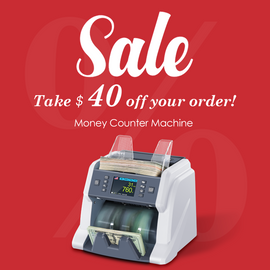
To survive this new regulatory landscape, retailers must bridge the gap between physical cash and digital transparency. This is where bank-grade technology becomes a "compliance shield." By utilizing advanced currency discriminators like the Ribao BC-55, retailers can transform a stack of anonymous bills into a detailed, auditable data set. The core of this solution is Dual Contact Image Sensor (CIS) technology, which scans every bill in high resolution, capturing not just the value, but the unique infrared and magnetic signatures that prove authenticity. This level of technical precision satisfies the "source of funds" verification requirements that 2026 bank auditors are looking for.
The most critical feature for 2026 compliance, however, is Serial Number Tracking and Automated Reporting. Equipment like the Ribao MC-165 doesn't just count money; it records the unique serial number of every single bill processed. This data can be exported into a digital "Cash Compliance Report" that can be shared directly with bank managers. When you can show your bank a digital log of every $50 and $100 bill that has passed through your registers—complete with timestamps and serial numbers—you move your business from the "high-risk" category to the "transparent" category. This technical solution effectively "digitizes" your cash flow, providing the same level of traceability as a credit card transaction and ensuring your banking relationship remains secure.
Actionable Steps: Building Your 2026 Compliance Shield
Don't wait for a letter from your bank's compliance department. Take these proactive steps to secure your business today:
- Implement a "Digital-First" Cash Policy: Treat every cash deposit as a data transaction. Use a Ribao discriminator to count and verify all cash, ensuring that your internal records match your bank deposits to the penny.
- Maintain a Serial Number Audit Trail: Enable serial number tracking on your Ribao device for all high-value denominations ($20, $50, $100). Save these logs daily to a secure cloud or local drive.
- Proactively Engage Your Bank Manager: Schedule a meeting with your business banker to show them your new cash handling protocols. Providing them with a sample "Cash Compliance Report" demonstrates that you are a low-risk, high-transparency client.
- Automate Your Reconciliation: Use Ribao’s software integration to link your cash counts directly to your accounting software. This eliminates manual entry errors and provides a "single source of truth" for your business revenue.
Conclusion: From Trust-Based to Data-Based Banking
The Federal Reserve’s "Innovation Within Limits" proposal is a clear signal that the banking world is moving from a trust-based model to a data-based model. In this new reality, simply being an honest business owner is no longer enough; you must have the data to prove it. By investing in Ribao’s bank-grade automation and serial number tracking, you are doing more than just speeding up your end-of-day count—you are future-proofing your business against the rising tide of regulatory scrutiny. The retailers who thrive in 2026 will be those who recognize that cash is not just currency, but a data point that must be managed with technical precision. Secure your margins, secure your bank account, and secure your future with the power of verifiable cash data.
Is your business ready for the 2026 compliance shift? Learn how Ribao can help you build a verifiable cash audit trail at Ribao Contact Page.